<?xml version='1.0' encoding='UTF-8'?>
<?xml-stylesheet href="/static/style.xsl" type="text/xsl"?>
<feed xmlns="http://www.w3.org/2005/Atom" xml:lang="en">
  <id>https://cve.radiocsirt.org/rss/recent/all/10</id>
  <title>Most recent entries from all</title>
  <updated>2026-10-24T02:37:46.683289+00:00</updated>
  <author>
    <name>Vulnerability-Lookup</name>
    <email>csirt@opendfir.org</email>
  </author>
  <link href="https://cve.radiocsirt.org" rel="alternate"/>
  <generator uri="https://lkiesow.github.io/python-feedgen" version="1.0.0">python-feedgen</generator>
  <subtitle>Contains only the most 10 recent entries.</subtitle>
  <entry>
    <id>https://cve.radiocsirt.org/vuln/euvd-2026-75214</id>
    <title>EUVD-2026-75214</title>
    <updated>2026-10-24T02:37:46.686133+00:00</updated>
    <content>EUVD-2026-75214</content>
    <link href="https://cve.radiocsirt.org/vuln/euvd-2026-75214"/>
  </entry>
  <entry>
    <id>https://cve.radiocsirt.org/vuln/fkie_cve-2024-29196</id>
    <title>fkie_cve-2024-29196</title>
    <updated>2026-10-24T02:37:46.686177+00:00</updated>
    <content type="xhtml">
      <div xmlns="http://www.w3.org/1999/xhtml">
        <p>phpMyFAQ is an open source FAQ web application for PHP 8.1+ and MySQL, PostgreSQL and other databases. There is a Path Traversal vulnerability in Attachments that allows attackers with admin rights to upload malicious files to other locations of the web root. This vulnerability is fixed in 3.2.6.</p>
      </div>
    </content>
    <link href="https://cve.radiocsirt.org/vuln/fkie_cve-2024-29196"/>
  </entry>
  <entry>
    <id>https://cve.radiocsirt.org/vuln/ghsa-mmh6-5cpf-2c72</id>
    <title>GHSA-mmh6-5cpf-2c72 — phpMyFAQ Path Traversal in Attachments</title>
    <updated>2026-10-24T02:37:46.686216+00:00</updated>
    <content type="xhtml">
      <div xmlns="http://www.w3.org/1999/xhtml"><p><strong>Affected:</strong> Packagist: phpmyfaq/phpmyfaq</p>
<p>### Summary
There is a Path Traversal vulnerability in Attachments that allows attackers with admin rights to upload malicious files to other locations of the web root.</p>
<p>### PoC
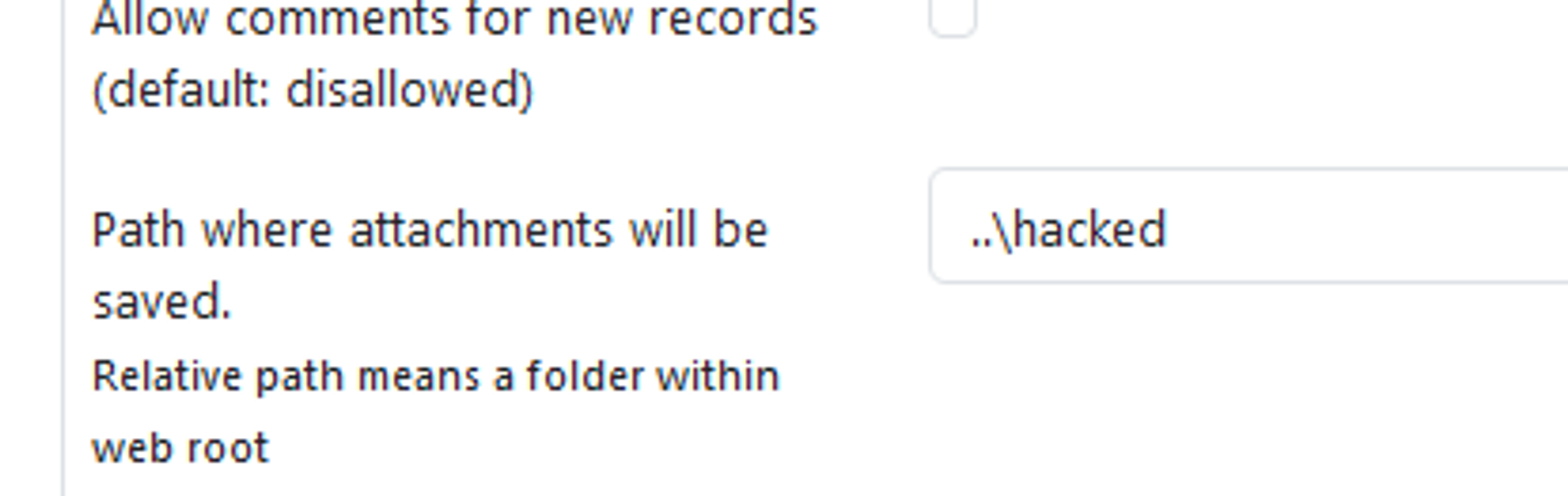
1. In settings, the attachment location is vulnerable to path traversal and can be set to e.g ..\hacked
![image](https://github.com/thorsten/phpMyFAQ/assets/63487456/6167ba74-254c-4aed-9c16-759e5ceafd81)</p>
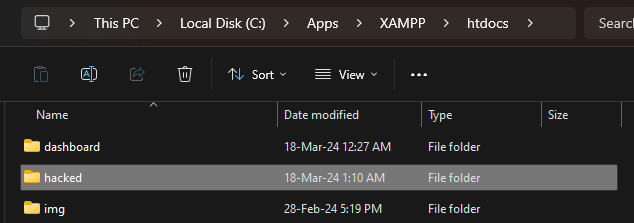
<p>2. When the above is set, attachments files are now uploaded to e.g C:\Apps\XAMPP\htdocs\hacked instead of C:\Apps\XAMPP\htdocs\phpmyfaq\attachments</p>
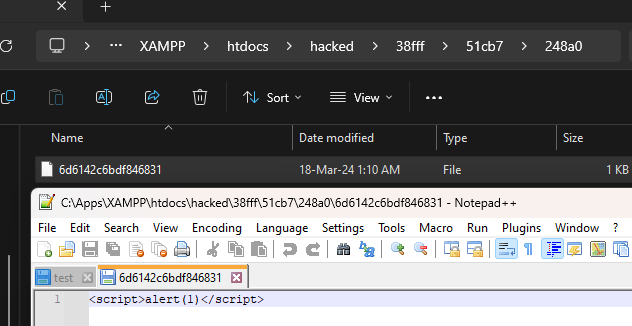
<p>3. Verify this by uploading an attachment and see that the "hacked" directory is now created in the web root folder with the attachment file inside.
![image](https://github.com/thorsten/phpMyFAQ/assets/63487456/325df0cc-e9ee-48bd-a7bb-1295199b4d9e)
![image](https://github.com/thorsten/phpMyFAQ/assets/63487456/beb10a6a-9d56-4607-8da6-49581991b1fe)</p>
<p>### Impact
Attackers can potentially upload malicious files outside the specified directory.</p></div>
    </content>
    <link href="https://cve.radiocsirt.org/vuln/ghsa-mmh6-5cpf-2c72"/>
  </entry>
  <entry>
    <id>https://cve.radiocsirt.org/vuln/gsd-2024-29196</id>
    <title>gsd-2024-29196</title>
    <updated>2026-10-24T02:37:46.686251+00:00</updated>
    <content>gsd-2024-29196</content>
    <link href="https://cve.radiocsirt.org/vuln/gsd-2024-29196"/>
  </entry>
</feed>