<?xml version='1.0' encoding='UTF-8'?>
<?xml-stylesheet href="/static/style.xsl" type="text/xsl"?>
<feed xmlns="http://www.w3.org/2005/Atom" xml:lang="en">
  <id>https://cve.radiocsirt.org/rss/recent/all/10</id>
  <title>Most recent entries from all</title>
  <updated>2026-10-12T23:54:59.779831+00:00</updated>
  <author>
    <name>Vulnerability-Lookup</name>
    <email>csirt@opendfir.org</email>
  </author>
  <link href="https://cve.radiocsirt.org" rel="alternate"/>
  <generator uri="https://lkiesow.github.io/python-feedgen" version="1.0.0">python-feedgen</generator>
  <subtitle>Contains only the most 10 recent entries.</subtitle>
  <entry>
    <id>https://cve.radiocsirt.org/vuln/euvd-2026-238692</id>
    <title>EUVD-2026-238692</title>
    <updated>2026-10-12T23:54:59.857526+00:00</updated>
    <content>EUVD-2026-238692</content>
    <link href="https://cve.radiocsirt.org/vuln/euvd-2026-238692"/>
  </entry>
  <entry>
    <id>https://cve.radiocsirt.org/vuln/fkie_cve-2024-24808</id>
    <title>fkie_cve-2024-24808</title>
    <updated>2026-10-12T23:54:59.857560+00:00</updated>
    <content type="xhtml">
      <div xmlns="http://www.w3.org/1999/xhtml">
        <p>pyLoad is an open-source Download Manager written in pure Python. There is an open redirect vulnerability due to incorrect validation of input values when redirecting users after login. pyLoad is validating URLs via the `get_redirect_url` function when redirecting users at login. This vulnerability has been patched with commit fe94451.</p>
      </div>
    </content>
    <link href="https://cve.radiocsirt.org/vuln/fkie_cve-2024-24808"/>
  </entry>
  <entry>
    <id>https://cve.radiocsirt.org/vuln/ghsa-g3cm-qg2v-2hj5</id>
    <title>GHSA-g3cm-qg2v-2hj5 — pyLoad open redirect vulnerability due to improper validation of the is_safe_url function</title>
    <updated>2026-10-12T23:54:59.857593+00:00</updated>
    <content type="xhtml">
      <div xmlns="http://www.w3.org/1999/xhtml"><p><strong>Affected:</strong> PyPI: pyload-ng</p>
<p>### Summary
Open redirect vulnerability due to incorrect validation of input values when redirecting users after login.</p>
<p>### Details
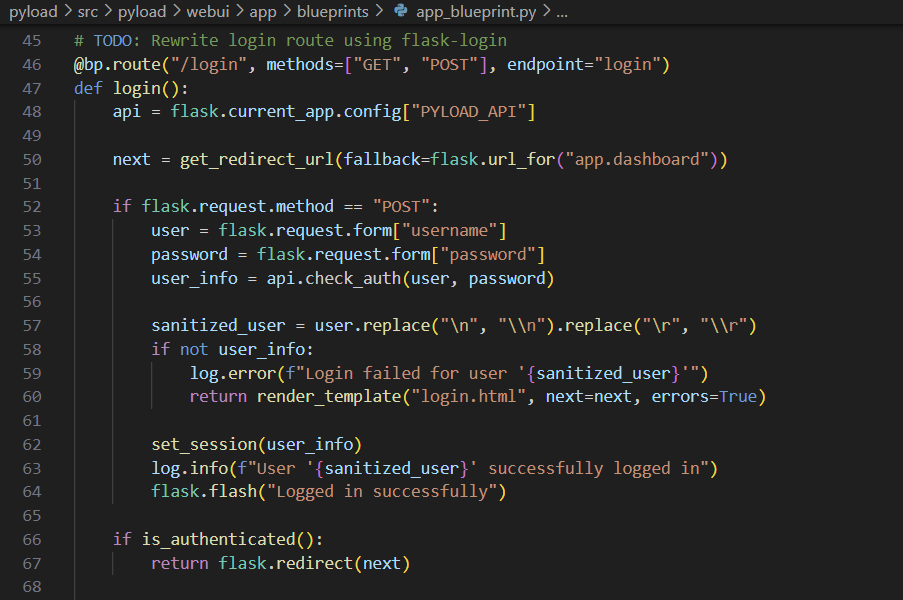
pyload is validating URLs via the `get_redirect_url` function when redirecting users at login.
![301715649-f533db41-d0bd-44f7-8735-be1887fbd06c](https://github.com/pyload/pyload/assets/114328108/7fbec2ed-05ed-46e6-847f-05132cf3f136)</p>
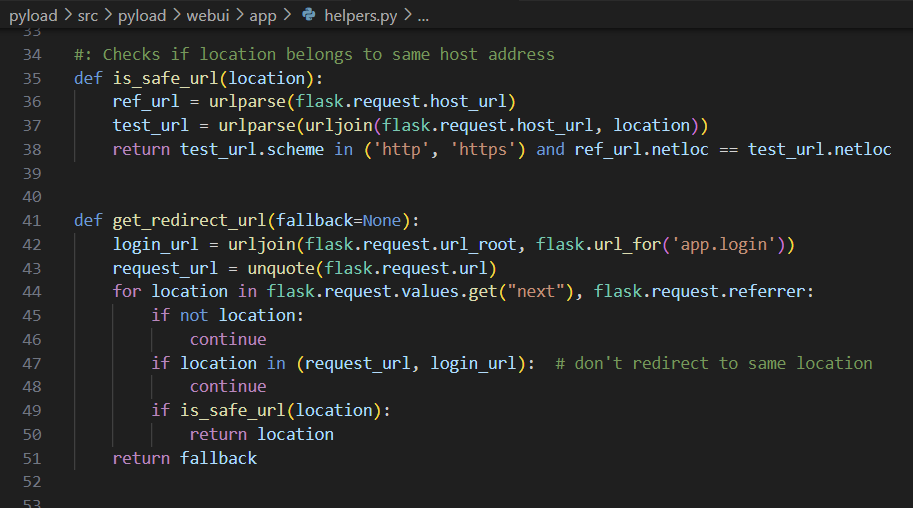
<p>The URL entered in the `next` variable goes through the `is_safe_url` function, where a lack of validation can redirect the user to an arbitrary domain.
![301715667-2819b1d3-8a14-42f4-89c8-3d2fa84fc309](https://github.com/pyload/pyload/assets/114328108/613484f3-8097-4871-887d-8fa5eec817cc)</p>
<p>The documentation in the urllib library shows that improper URLs are recognized as relative paths when using the `urlparse` function. (https://docs.python.org/3/library/urllib.parse.html#urllib.parse.urlparse)</p>
<p>For example, When an unusual URL like `https:///example.com` is entered, `urlparse` interprets it as a relative path, but in the actual request it is converted to `https://example.com` due to url normalization.</p>
<p>### PoC
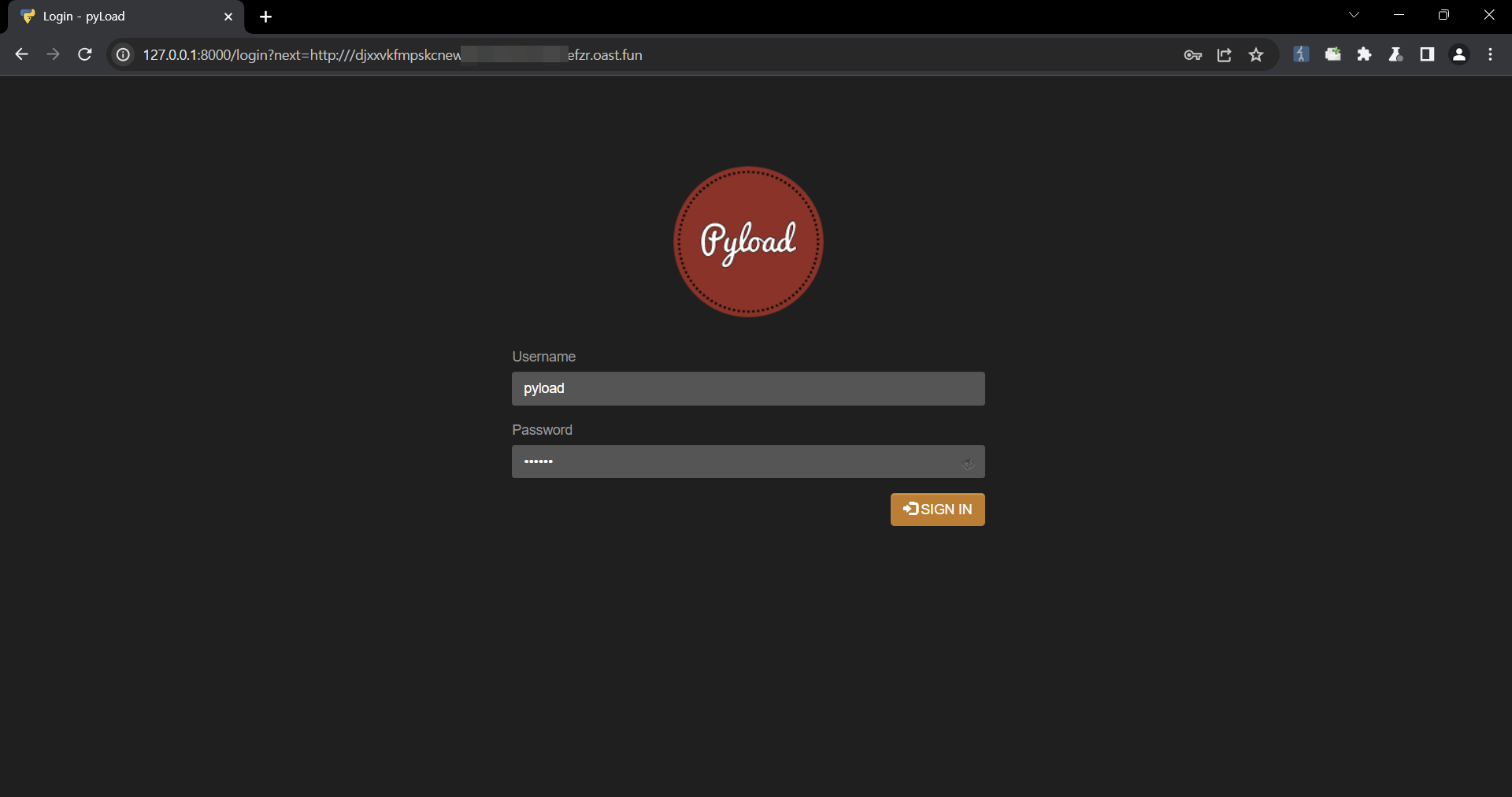
1. In the next variable, insert the URL to which you want to redirect the user.
![301715949-bb1451eb-5e84-451d-83b4-5c3e204d1df7](https://github.com/pyload/pyload/assets/114328108/6fe639ea-1f85-4715-bf6c-c9c8c4ee9c94)</p>
<p>2. Check that it is possible to bypass url validation and redirect users to an arbitrary url.
![301715824-3de6584a-878d-4ec4-a3d5-a34d11c6c0ac](https://github.com/pyload/pyload/assets/11…</p></div>
    </content>
    <link href="https://cve.radiocsirt.org/vuln/ghsa-g3cm-qg2v-2hj5"/>
  </entry>
  <entry>
    <id>https://cve.radiocsirt.org/vuln/gsd-2024-24808</id>
    <title>gsd-2024-24808</title>
    <updated>2026-10-12T23:54:59.857646+00:00</updated>
    <content>gsd-2024-24808</content>
    <link href="https://cve.radiocsirt.org/vuln/gsd-2024-24808"/>
  </entry>
  <entry>
    <id>https://cve.radiocsirt.org/vuln/pysec-2026-1817</id>
    <title>PYSEC-2026-1817 — pyLoad open redirect vulnerability due to improper validation of the is_safe_url function</title>
    <updated>2026-10-12T23:54:59.857660+00:00</updated>
    <content type="xhtml">
      <div xmlns="http://www.w3.org/1999/xhtml"><p><strong>Affected:</strong> PyPI: pyload-ng</p>
<p>### Summary
Open redirect vulnerability due to incorrect validation of input values when redirecting users after login.</p>
<p>### Details
pyload is validating URLs via the `get_redirect_url` function when redirecting users at login.
![301715649-f533db41-d0bd-44f7-8735-be1887fbd06c](https://github.com/pyload/pyload/assets/114328108/7fbec2ed-05ed-46e6-847f-05132cf3f136)</p>
<p>The URL entered in the `next` variable goes through the `is_safe_url` function, where a lack of validation can redirect the user to an arbitrary domain.

![301715667-2819b1d3-8a14-42f4-89c8-3d2fa84fc309](https://github.com/pyload/pyload/assets/114328108/613484f3-8097-4871-887d-8fa5eec817cc)</p>
<p>The documentation in the urllib library shows that improper URLs are recognized as relative paths when using the `urlparse` function. (https://docs.python.org/3/library/urllib.parse.html#urllib.parse.urlparse)</p>
<p>For example, When an unusual URL like `https:///example.com` is entered, `urlparse` interprets it as a relative path, but in the actual request it is converted to `https://example.com` due to url normalization.</p>
<p>### PoC
1. In the next variable, insert the URL to which you want to redirect the user.

![301715949-bb1451eb-5e84-451d-83b4-5c3e204d1df7](https://github.com/pyload/pyload/assets/114328108/6fe639ea-1f85-4715-bf6c-c9c8c4ee9c94)</p>
<p>2. Check that it is possible to bypass url validation and redirect users to an arbitrary url.
![301715824-3de6584a-878d-4ec4-a3d5-a34d11c6c0ac](https://github.com/pyload/pyload/assets/11…</p></div>
    </content>
    <link href="https://cve.radiocsirt.org/vuln/pysec-2026-1817"/>
  </entry>
</feed>
